The Best Handwriting Practice Paper for Kids in 2026 (A Parent's Guide)
The best handwriting practice paper for kids has a dotted middle guide line, wide kindergarten-friendly spacing, a large 8.5 by 11 inch page, and thick paper that does not bleed. Those four features do half the teaching for you, training correct letter height and proportion from the very first page. The wrong paper, plain ruled or spaced for an adult, quietly trains habits that take years to undo.
TL;DR
- The single most important feature is a dotted middle guide line. It teaches letter height.
- Look for wide spacing, around 5/8 inch or more, so small hands have room.
- A large 8.5 by 11 inch page beats a pocket notebook for early writers.
- Thick, no-bleed paper keeps pages clean and reusable as a reference.
- Practice 10 to 15 minutes a day, letters before words, effort before perfection.
If you have ever watched your five year old grip a pencil and try to squeeze a wobbly “B” between two lines that are far too close together, you already know the truth: not all handwriting paper is the same.
The right practice paper does half the teaching for you. The wrong kind, plain ruled paper or lines spaced for an adult, quietly trains bad habits that take years to undo.
This guide breaks down exactly what to look for in handwriting practice paper for kids, what to avoid, and how to use it so your child actually enjoys learning to write.
Why handwriting paper matters more than you think
Children are not born knowing how tall a lowercase “a” should be compared to a capital “A.” They learn it from the paper. Good handwriting paper uses a dotted middle line, a faint guide running between the top and bottom lines, that shows a child exactly where each letter starts, sits, and stops.
That single dotted line is the difference between a child who writes confidently and one who guesses.
What to look for in handwriting practice paper
1. A dotted middle guide line. This is non-negotiable. The dotted line teaches letter height and proportion. Plain two-line or college-ruled paper does not.
2. Wide line spacing. Young hands need room. Look for generous spacing, roughly 5/8 inch or wider for kindergarten. Lines spaced for adults force cramped, frustrated writing.
3. The right size page. A large 8.5 by 11 inch page gives small hands space to move. Pocket-sized notebooks are the wrong tool for early writers.
4. Quality paper that does not bleed. Thin paper means pencil smudges and marker bleed-through. Premium white paper keeps each page clean and reusable as a reference.
5. Plenty of pages. Handwriting is built through repetition. A book with 100 or more pages lasts through months of daily practice without you reordering.
The mistakes that slow kids down
- Starting with words before letters. Children should master single letters first, then move to short words like “of,” “to,” and “up.” Paper that rushes to full sentences overwhelms beginners.
- Using lined paper meant for older students. Narrow college-ruled lines are designed for fluent writers, not four to six year olds.
- Skipping the dotted guide. Without the middle line, kids have no reference for letter size, and inconsistency becomes a habit.
Not sure your child is ready to start formal practice yet? Our handwriting readiness checklist walks through the signs in two minutes, and pre-writing skills covers the shapes that come before letters.
How to use handwriting paper effectively
Keep sessions short. 10 to 15 minutes a day beats an hour once a week. Start each session with two or three letters. Let your child trace, then copy, then write from memory. Celebrate effort, not perfection. Progress in handwriting is slow and completely normal.
For Pre-K and kindergarten, focus on uppercase letters first, since they are simpler shapes, then lowercase, then your child’s own name. By first grade, most children are ready for short words and simple sentences. For the full sequence, our step-by-step guide on how to teach handwriting lays out the order teachers use.
Our recommendation
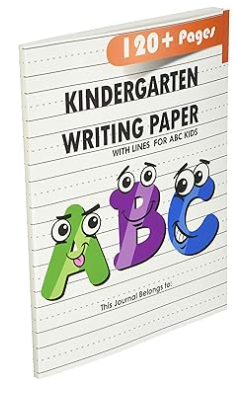
We designed our handwriting practice paper around every principle above: a clear dotted middle line, wide kindergarten-friendly spacing, a large 8.5 by 11 inch format, thick no-bleed white paper, and 122 pages of practice. It is built for exactly this stage, Pre-K, kindergarten, and first grade, and it is rated 4.8 from 12,478 families. If you are torn between printing your own sheets and buying a bound book, our workbook vs free printables comparison weighs the trade-offs.
You can see the bound handwriting book here, or start tonight with our free Activity Pages for Toddlers, 26 tracing pages and 26 coloring pages at no cost.
Common questions about handwriting paper
Below are the questions parents ask most about choosing handwriting practice paper, with short answers you can use today.
What kind of paper is best for a child learning to write?
The best paper for a child learning to write has a dotted middle guide line between a solid top and bottom line, wide spacing of about 5/8 inch or more, and thick paper that does not bleed. The dotted midline is the key feature, because it shows a child exactly how tall each letter should be.
What is the dotted middle line on handwriting paper for?
The dotted middle line teaches letter height and proportion. It shows a child where a lowercase letter stops and where a capital reaches, so letters come out a consistent size. Plain two-line or college-ruled paper has no midline, which leaves a young writer guessing.
What size handwriting paper is best for kindergarten?
A large 8.5 by 11 inch page with wide line spacing is best for kindergarten. Small hands need room to move, so generous spacing of roughly 5/8 inch or wider suits four to six year olds. Pocket-sized notebooks and narrow college-ruled lines are the wrong tool for early writers.
How much handwriting practice should a child do each day?
About 10 to 15 minutes a day is ideal for young children. A short, happy session every day builds more skill than a long, frustrating one once a week. Start with two or three letters, let your child trace then copy then write from memory, and praise effort over perfection.
Written by Smith John, founder of Tiny Writers Co and author of “Kindergarten Writing Paper with Lines for ABC Kids.” This guide is general education for parents and caregivers. If you have specific concerns about your child’s fine motor development, speak with a teacher, pediatrician, or pediatric occupational therapist.
Ready for daily practice?
Our bound handwriting book gives 122 pages of trace-then-write practice for ages 4 to 6. Rated 4.8 by 12,478 families.