Free Handwriting Practice Sheets: A to Z Letter Tracing (Printable PDF)
These free handwriting practice sheets give your child one page for every letter, A to Z. Each sheet shows where to start the capital and lowercase letter, then moves from tracing to writing alone on three-line rows. They print on US Letter paper, there is no sign-up, and they suit children ages 4 to 6.
Free for home and classroom use. Print at actual size (100%) on US Letter paper.
Choose a letter
-
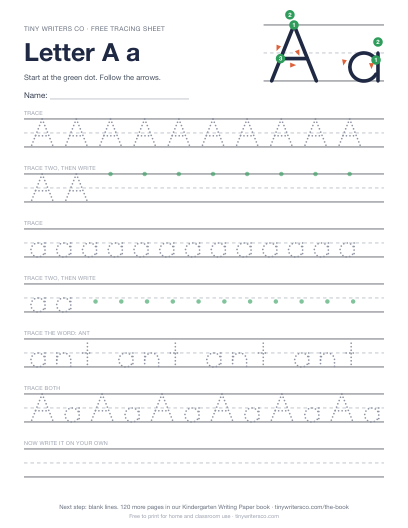 A aPDF ↓
-
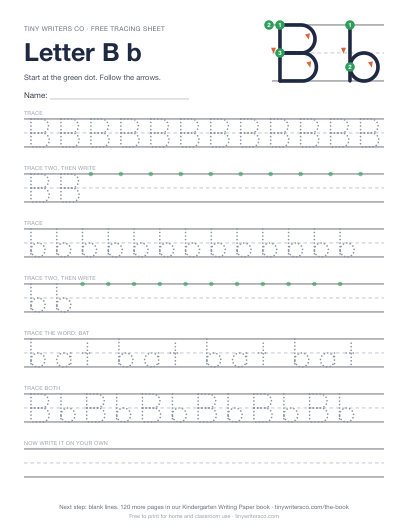 B bPDF ↓
-
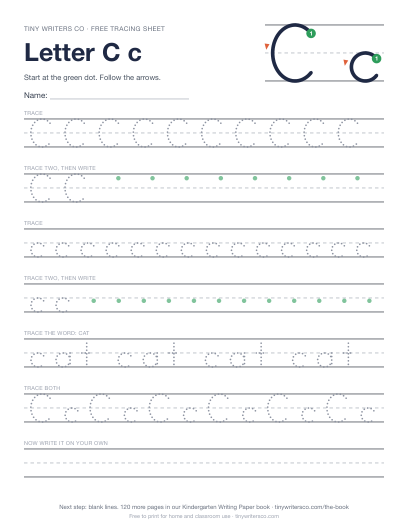 C cPDF ↓
-
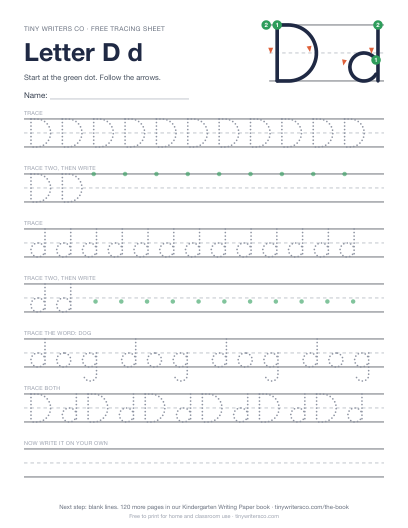 D dPDF ↓
-
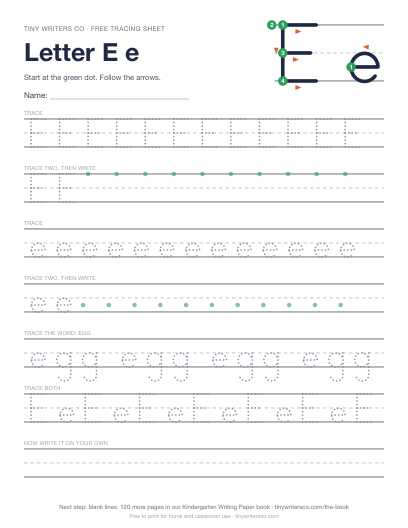 E ePDF ↓
-
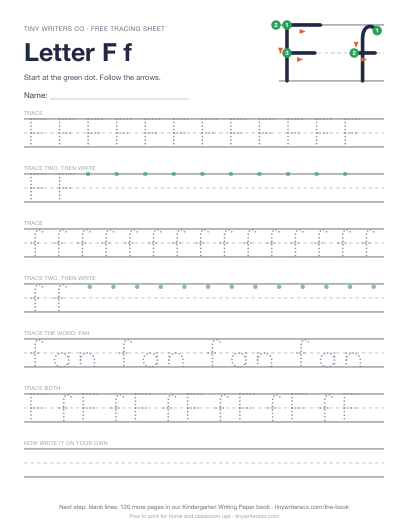 F fPDF ↓
-
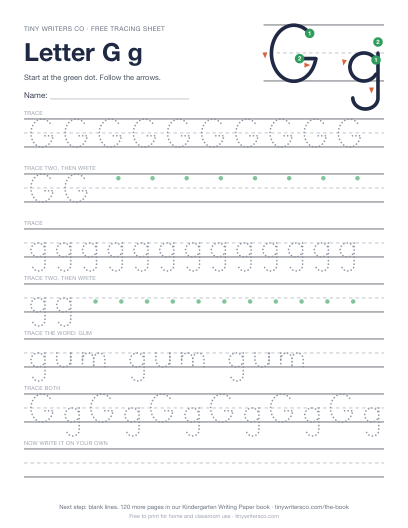 G gPDF ↓
-
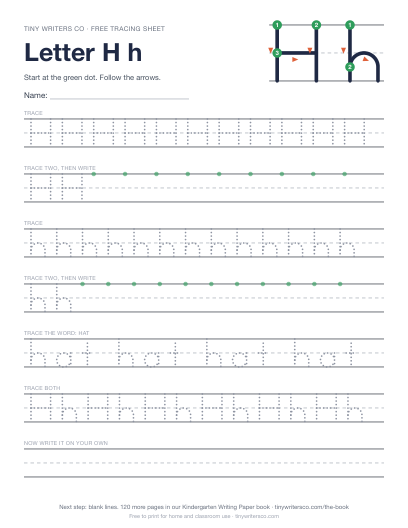 H hPDF ↓
-
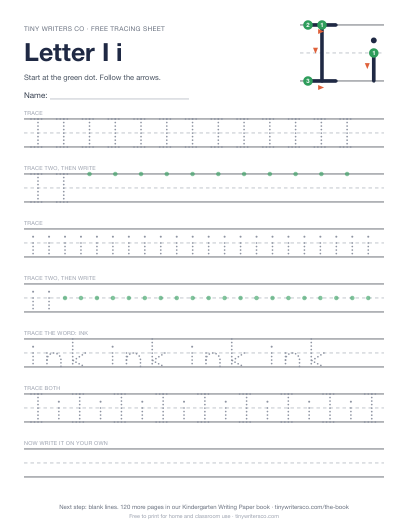 I iPDF ↓
-
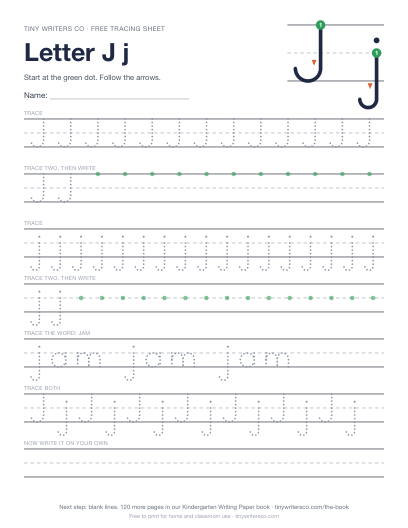 J jPDF ↓
-
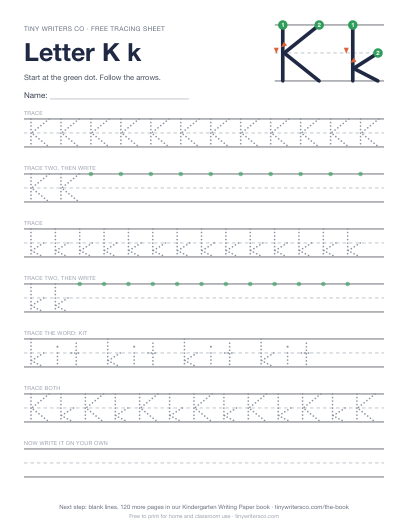 K kPDF ↓
-
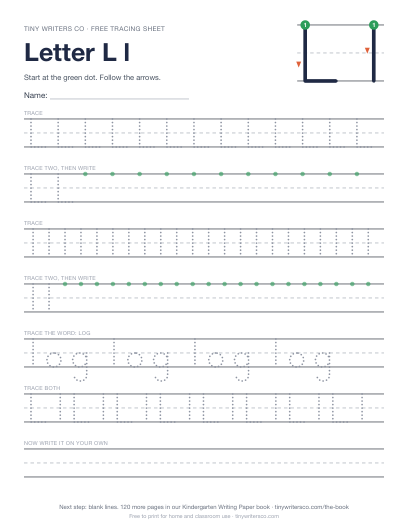 L lPDF ↓
-
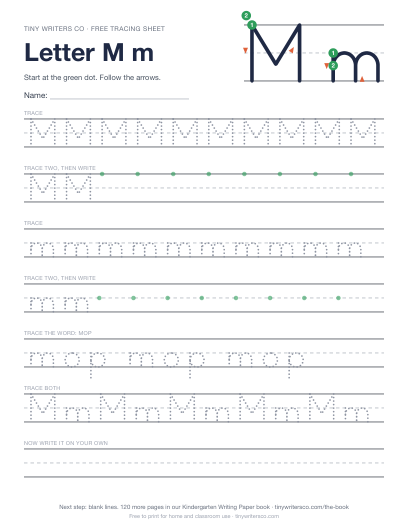 M mPDF ↓
-
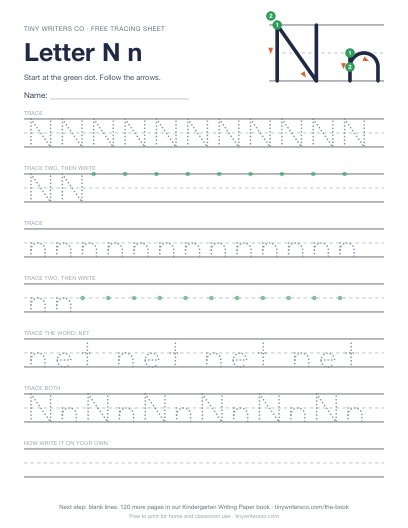 N nPDF ↓
-
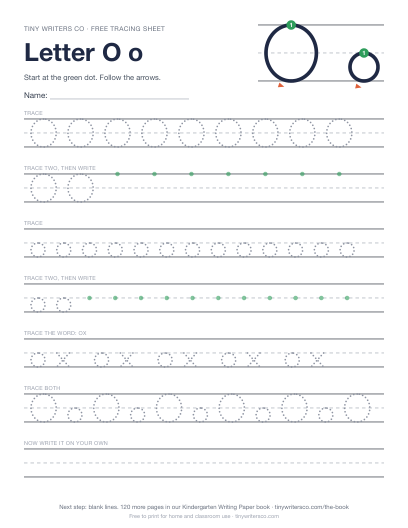 O oPDF ↓
-
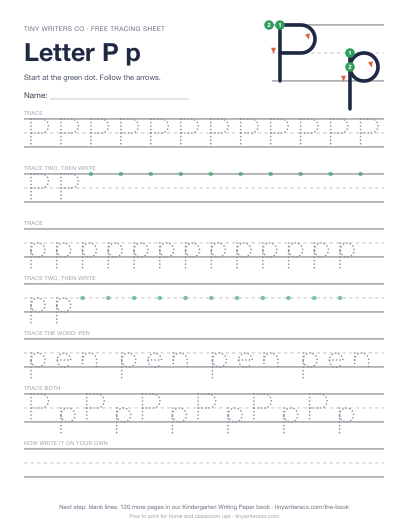 P pPDF ↓
-
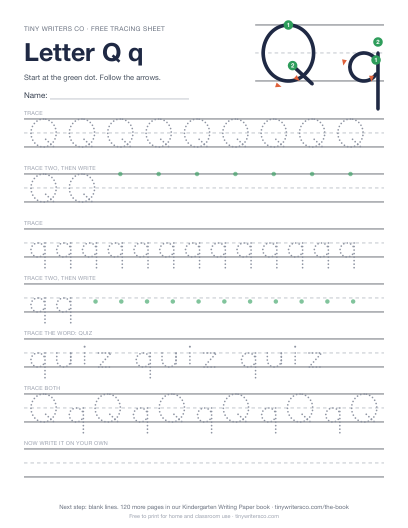 Q qPDF ↓
-
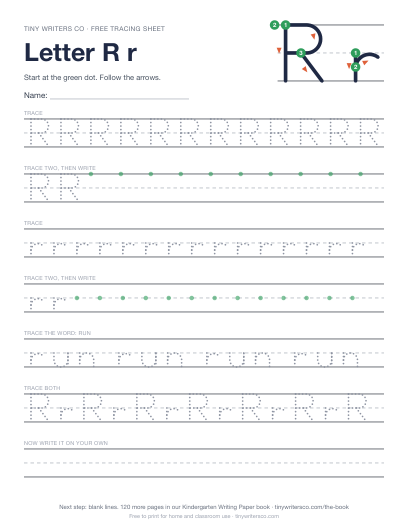 R rPDF ↓
-
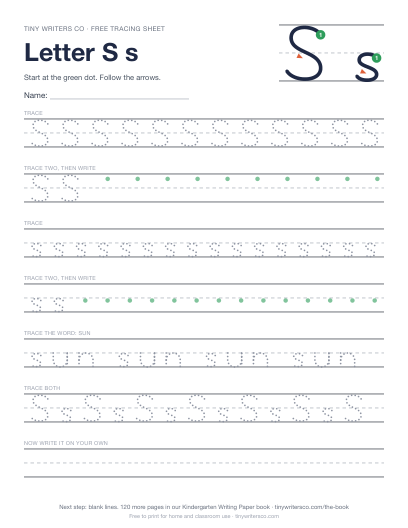 S sPDF ↓
-
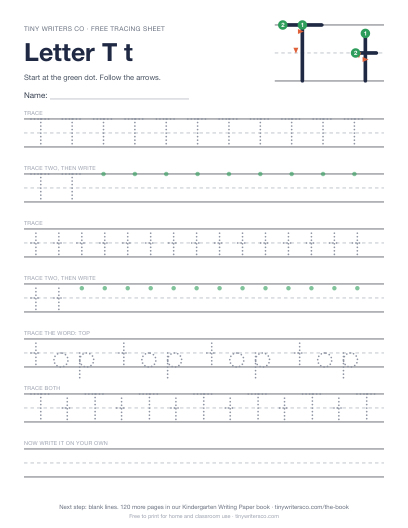 T tPDF ↓
-
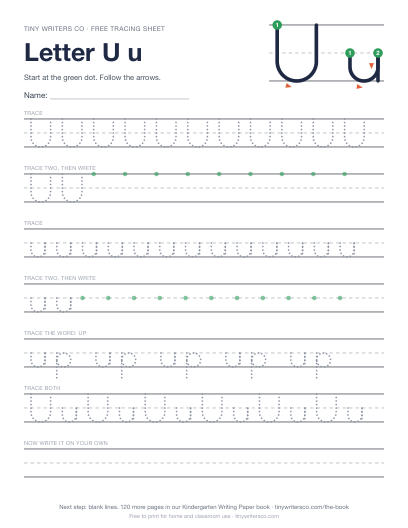 U uPDF ↓
-
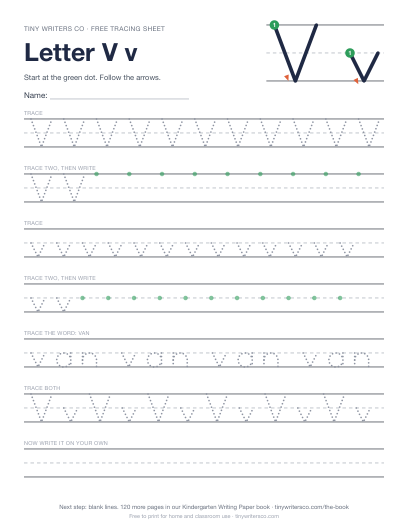 V vPDF ↓
-
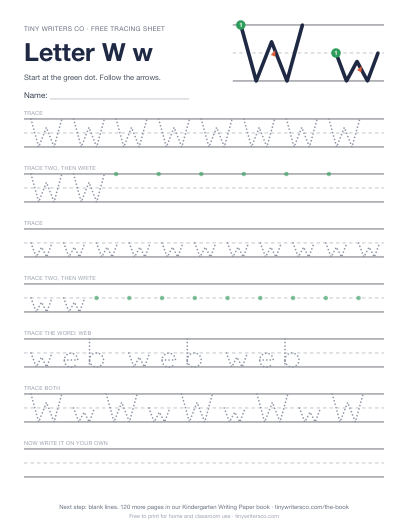 W wPDF ↓
-
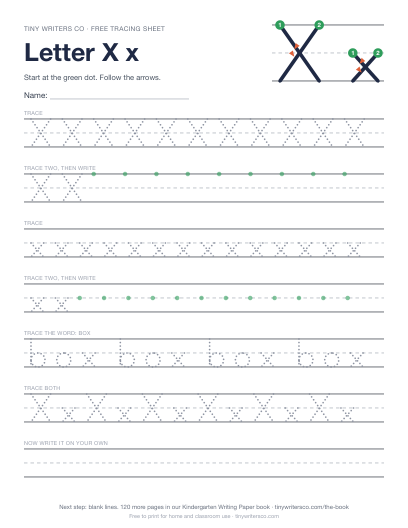 X xPDF ↓
-
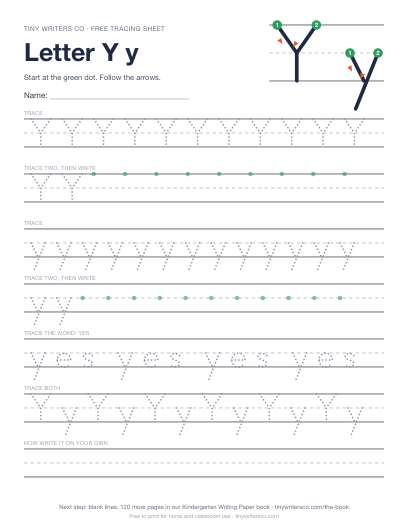 Y yPDF ↓
-
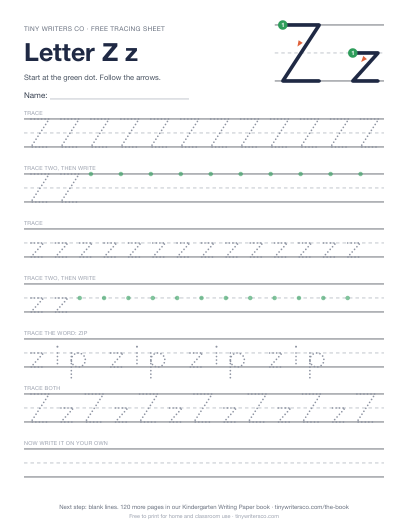 Z zPDF ↓
Ready for blank lines? Print our free kindergarten writing paper in three line sizes.
What is on each handwriting practice sheet?
Every sheet follows the same eight-step page, so your child learns the routine once and then just changes letters. The page starts with a big model of the capital and lowercase letter, and ends with an empty row where your child writes without help.
| Row | What your child does | Why it is there |
|---|---|---|
| Model letters | Looks at the big letter, finds the green dot marked 1, follows the orange arrows | Shows where each stroke starts and which way it goes |
| Trace the capital | Traces a full row of dotted capitals | Repeats the same correct motion |
| Trace two, then write | Traces two capitals, then writes the rest from a green start dot | First step away from the dotted guide |
| Trace the lowercase | Traces a full row of dotted lowercase letters | Same routine for the small letter |
| Trace two, then write | Traces two lowercase letters, then writes alone from the dots | Builds independence on the small letter |
| Trace a word | Traces a short word that uses the letter, such as cat, sun or zip | Moves from single letters to letters side by side |
| Trace both | Traces capital and lowercase pairs | Practices switching between the two shapes |
| Write it alone | Writes the letter on an empty row | Shows you what your child can do without a guide |
Every row uses the same lines our book uses: a solid top line, a dotted midline and a solid baseline. Tall letters touch the top line, small letters stop at the dotted line, and tails like the one on g drop below the baseline.
Which letters should your child practice first?
Start with capital letters made of straight lines: L, F, E, H, T and I. Occupational therapists recommend teaching capitals before lowercase and grouping letters by how they are formed, not by alphabet order, as Victoria Wood, OTR/L, explains on The OT Toolbox [1]. Lowercase letters come next, then names and short words.
You do not need to print A first, because A is built from diagonals, which are harder to form than straight lines [1]. Print the L, F, E, H, T and I sheets for the first week, then follow the full sequence in our guide to what order to teach letters. Every sheet is also in the single A to Z file, so you can print the whole set once and pull pages in your own order.
How do you use a tracing sheet so it actually helps?
Make the start dot the rule. Before your child traces, point to the green dot marked 1 and trace the first stroke in the air together. The OT Toolbox warns that children who trace worksheets without formation cues often start letters in the wrong place, and that habit is hard to undo [2].
A few things make each sheet work harder:
- Keep it to one sheet, or part of one, in a session. We suggest 10 to 15 minutes a day rather than one long sitting.
- Check the pencil hold before the letters. If writing tires your child quickly, our guide to the tripod pencil grip shows what a comfortable hold looks like.
- If lines and circles are still wobbly, go back a step. The pre-writing shapes come before letters.
- Praise the start point and direction, not just neatness. A slightly wobbly letter that starts in the right place is the win at this age.
The bottom row of every sheet has no dots on purpose. When your child can fill it with letters that start at the right place, that letter is ready for blank-line practice.
When should your child stop tracing and write on blank lines?
Move a letter to blank lines once your child starts it at the right point and fills the “write it alone” row without looking back at the dots. Some letters get there in a few days. Others, often the diagonal and curved ones, take longer, so letters can move over one at a time.
Tracing teaches the path. Writing on empty lines is where your child has to remember it, and that is the skill school asks for. Our guide to tracing vs free writing lists the readiness signs in more detail.
For that next stage, printing gets expensive. Home printing runs roughly 5 to 10 cents a page in black and white once ink and paper are counted, according to Toner Buzz [3]. A term of daily practice can mean more than a hundred pages.
| Printing blank lined sheets at home | Our blank writing paper book | |
|---|---|---|
| Pages | As many as you print | 120 blank practice pages |
| Cost | Roughly 5 to 10 cents a page [3] | $9.99 for the paperback |
| Lines | Depends on the file you find | Solid top line, dotted midline, solid baseline on every row |
| Pages stay together | No, loose sheets | Yes, bound with a glossy cover |
| Tracing letters printed | Depends | None, so your child writes on their own |
That is why we made Kindergarten Writing Paper with Lines for ABC Kids: 120 blank pages of the same three-line rows these sheets use, bound in one 8.5 by 11 inch book. It has no tracing letters, so it is the next step after these sheets, not a copy of them. It is rated 4.8 stars from 12,487 ratings on Amazon.
Questions parents ask
Are these handwriting practice sheets really free?
Yes. All 26 sheets are free to download and print for home or classroom use, with no email sign-up and nothing to buy. You can download one letter at a time or the whole A to Z set as a single PDF.
What paper size do the sheets print on?
They are made for US Letter paper, 8.5 by 11 inches, in portrait. Print at actual size (100%) so the rows keep their spacing. Each sheet is black and gray line art with small green and orange marks, so it prints well in black and white too.
Can my 3 year old use these sheets?
Usually not yet: children typically copy a cross and a square around ages 4 to 5, according to North Shore Pediatric Therapy [4], and letters are built from those same strokes. If your 3 year old already draws a cross with control, try the capital L or T sheet. If it ends in frustration, put it away for a few weeks.
What handwriting style do the letters use?
The letters use a simple print style built from straight lines and circles, often called ball-and-stick print. If your child’s school teaches a different model, follow the teacher’s version so your child does not learn two shapes for the same letter.
Can teachers copy these sheets for a class?
Yes. Teachers can print and copy them for their own students. Please link to this page rather than uploading the files somewhere else, so families always get the current version.
Why does each sheet have a word to trace?
The short word shows the letter working next to other letters, which is what your child will do in real writing. The words are kept short and familiar, from ant and bat to yes and zip, so the focus stays on the letter.
Sources and references
- Victoria Wood, OTR/L. “Handwriting Without Tears Letter Order.” The OT Toolbox. https://www.theottoolbox.com/handwriting-without-tears-letter-order/
- “Letter Formation Activities and Tools That Work.” The OT Toolbox. https://www.theottoolbox.com/letter-formation/
- “Printing Costs: How to Accurately Calculate Your Printing Cost Per Page.” Toner Buzz. https://www.tonerbuzz.com/blog/printing-costs/
- “Developmental Milestones for Pre-Writing and Writing Skills.” North Shore Pediatric Therapy. https://www.nspt4kids.com/parenting/developmental-milestones-pre-writing-writing-skills
Written by Smith John, founder of Tiny Writers Co and author of “Kindergarten Writing Paper with Lines for ABC Kids.” These sheets and this guide are general education for parents and teachers. If you have concerns about your child’s handwriting or development, speak with a teacher, pediatrician, or pediatric occupational therapist.
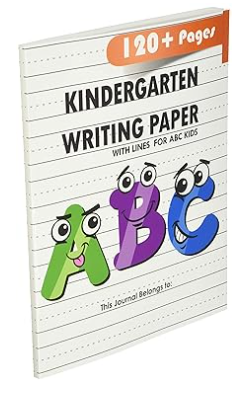
Done tracing? Next come blank lines
120 blank pages with the same three-line rows, bound in one book. No tracing letters, so your child writes on their own. Rated 4.8 from 12,487 ratings.