Free Handwriting Paper Maker: Printable Lined Paper PDF
Make free printable handwriting paper in the exact line size your child needs. Pick a grade or a row height, choose a gap between rows, a picture box or a title, then download a one-page PDF and print as many copies as you like. It works on a phone or computer, with no sign-up.
Line sizes from Pacon's Ruled Paper Guide· Last verified November 12, 2026· By Smith John
Which line size should you pick for each grade?
Pick the grade button and the maker sets the row height for you. Each grade uses the Zaner-Bloser ruling that Pacon, a large US maker of school paper, lists for that grade in its ruled paper guide [1]. Start one size bigger if your child’s letters keep bursting through the top line.
| Grade | Row height (top line to baseline) | Dotted midline | Same ruling as |
|---|---|---|---|
| Pre-K | 1 1/8 inch | 9/16 inch | Zaner-Bloser paper for pre-K and K [1] |
| Kindergarten | 3/4 inch | 3/8 inch | Zaner-Bloser paper for K [1] |
| Grade 1 | 5/8 inch | 5/16 inch | Zaner-Bloser paper for grade 1 and D’Nealian paper for K [1] |
| Grade 2 | 1/2 inch | 1/4 inch | Zaner-Bloser paper for grade 2 and D’Nealian paper for grades 1 to 3 [1] |
| Grade 3 | 3/8 inch | 3/16 inch | Zaner-Bloser paper for grades 3 and 4 [1] |
The row height menu also has 2 inch, 1 1/2 inch, 1 inch and 7/8 inch rows. All of them appear in Pacon’s guide too. The very large rows suit a child who is just starting to write letters at all.
Zaner-Bloser and D’Nealian are handwriting programs many US schools use, and we are not linked to either. If your child’s school sends home its own paper, match that first.
How does the maker build the paper?
Every line size is sourced from Pacon’s Ruled Paper Guide [1], and the maker draws each row from three numbers defined there. The ruling is the distance from the top line to the baseline. The dotted midline sits halfway down. The gap between rows is half a row by default, which matches the skip space on most rulings in Pacon’s guide.
Your PDF is made in your browser, so nothing you type is sent to us. The page is set to exactly 8.5 by 11 inches (or A4), and the file asks your printer not to scale it. That setting, called PrintScaling, is part of the PDF standard [2].
We tested the maker on 40 mixes of size, gap, paper and layout. A script measured every line in each test PDF and fails the build if any row, midline or gap is off by more than 1/100 of an inch. All 40 passed.
How do you get the lines to print at the right size?
Always print at actual size. Download the PDF rather than printing the preview, then choose “Actual size” or “100%” in the print window. “Fit to page” shrinks every row a little, so a 3/4 inch row can quietly become 5/8 inch.
Every page has a bar at the bottom left that is exactly 1 inch long when printed correctly. Hold a ruler to it after your first copy. If it is short, fix the scale setting before you print a stack. The file is accurate to 1/100 of an inch, so the printer and its settings are the real limit on accuracy.
What do the settings change?
- The gap between rows: “Half a row” matches classroom paper. “None” stacks rows so each baseline is also the next top line, which fits more writing on a page. “A full row” leaves a wide gap, handy for children whose tails and tall letters crash into each other.
- The dotted midline: turn it off for two-line paper once your child sizes small letters without the guide.
- The picture box: a top third or top half box turns the page into story paper, where your child draws first and then writes about the picture.
- Line colors: classic blue lines with a red baseline, gray to save colored ink, or black.
- The title: type your child’s name or the week’s letters, up to 60 characters. Our letter order guide suggests which letters to start with.
What can this maker not do?
It makes blank lined paper only. It does not put letters, words or tracing dots on the rows; for that, use our free A to Z handwriting practice sheets.
It also does not copy any program’s special paper exactly. Some programs use their own line styles, so ask the teacher if you want a perfect match. Titles can use letters with accents, like José or Zoë, but not emoji or non-Latin scripts, because the PDF uses the standard built-in fonts. Some printers cannot print right to the edge, so on A4 the ends of the lines may be trimmed slightly.
Should you print paper or buy a writing book?
Printing works well for trying sizes and for homework pages. For a page every day, a bound book costs less per page and keeps your child’s work in one place. Home printing runs roughly 5 to 10 cents a page in black and white, according to Toner Buzz [3].
Kindergarten Writing Paper with Lines for ABC Kids is 120 blank pages of three-line rows in one 8.5 by 11 inch book, with no tracing letters, rated 4.8 stars from 12,487 ratings on Amazon. If you only need ready-made kindergarten sheets, our free kindergarten writing paper has five pages you can download in one click.
Questions parents ask
Is the handwriting paper maker free?
Yes. Make and print as many pages as you like for home or classroom use. There is no sign-up, no watermark and nothing to install.
Does it work on a phone?
Yes. Pick your settings on the phone, download the PDF, and print it from the phone or send it to a computer. On an iPhone the PDF opens in a viewer first; use the Share button and then Print.
What is primary paper?
Primary paper is handwriting paper for young children: wide rows with a solid top line, a dotted midline and a baseline. Teachers also call it primary lined paper or primary writing paper. The paper this maker builds at kindergarten size is primary paper, and our guide to the best handwriting practice paper for kids explains what else to look for.
Why is the baseline red?
A red baseline gives a beginning writer one line that stands out as the place every letter sits. Many classroom papers in Pacon’s guide print the baseline in red for the same reason [1]. Choose gray or black if you print in black and white.
Can teachers use it for a class?
Yes. Make the size your class uses, add a title such as the week’s letters, and copy the PDF for your students. Please link to this page rather than uploading the files elsewhere.
Sources and references
- Pacon Corporation. “Ruled Paper Guide.” https://pacon.com/files/pacon_content/Miscellaneous%20Images/Ruled%20Paper%20Guide_r07-21-16_low.pdf
- “Document management: Portable document format, Part 1: PDF 1.7” (ISO 32000-1:2008), viewer preferences, PrintScaling. Adobe. https://opensource.adobe.com/dc-acrobat-sdk-docs/pdfstandards/PDF32000_2008.pdf
- “Printing Costs: How to Accurately Calculate Your Printing Cost Per Page.” Toner Buzz. https://www.tonerbuzz.com/blog/printing-costs/
Built by Smith John, founder of Tiny Writers Co and author of “Kindergarten Writing Paper with Lines for ABC Kids.” Zaner-Bloser and D’Nealian are trademarks of their owners. This tool and guide are general information for parents and teachers. If you have concerns about your child’s handwriting, speak with their teacher or a pediatric occupational therapist.
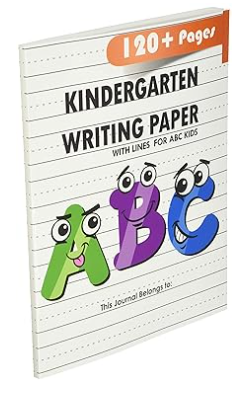
120 pages, no printing
Three-line rows on every page, bound in one 8.5 by 11 inch book. No tracing letters, so your child writes on their own. Rated 4.8 from 12,487 ratings.